
Guadalupe County Parole or Probation
Parole and probation both place a person in the community under rules, but they arise in different ways. Parole is conditional release from a prison sentence. The New Mexico Adult Parole Board makes parole decisions, while the New Mexico Corrections Department Probation and Parole Division supervises the person after release. Probation is imposed by a court, often through a judgment that suspends part of a sentence. The same NMCD division may supervise probation, yet the court remains the source for the order and later changes.
Neither status means the sentence has ended. A person may have left Guadalupe County Correctional Facility, started parole, and remained under NMCD control in the community. Another person may have left a local detention episode on a court order that starts probation. A third person may have completed all supervision and received a discharge. Those are distinct events. The source must state which one occurred.
| Point | Parole | Probation |
|---|---|---|
| Who orders it | Adult Parole Board under the sentence framework | Sentencing court |
| What came first | State prison custody | A court judgment, with or without prior jail time |
| Key proof | Parole release record, conditions, and later discharge certificate | Judgment, probation order, and termination order |
| Who supervises | NMCD Probation and Parole Division | NMCD Probation and Parole Division when assigned |
- Parole
- Conditional community release while a prison sentence remains in force.
- Probation
- Community supervision ordered by a court as part of a sentence.
- Discharge
- The formal end of the sentence or supervision duty.
- Absconder
- A status formally determined by the supervising authority, not a label for one missed visit.
Check Guadalupe County Supervision
The official starting point is the NMCD Offender Search. Its scope includes people incarcerated or on probation or parole. The direct form permits Last Name, First Name, Offender Number, age fields, and Offender Status. Select Include Inactive when looking for an older supervision or discharge record. Active can omit a completed case. “Absconder Only” is a separate choice for an unresolved supervision status and does not mean the person was discharged.
NMCD states that prison information updates nightly and that people move. A result should be copied exactly, including its office or location and the date it was accessed. A missing record is not proof of release or discharge. NMCD also says it has no jurisdiction over county and city detention facilities, so a local jail release requires the county release record and the court case.
- Collect the full name, name variants, date of birth, NMCD number if known, and the sentencing case number.
- Search NMCD with the most precise identifier and choose Include Inactive when completed supervision may be involved.
- Match the result by NMCD number, demographics, offenses, and the displayed office. Do not rely on a name alone.
- Use the NMCD regional directory or central office to confirm which unit holds the case.
- For parole, request the public release, supervision, transfer, termination, and discharge entries. For probation, compare the court judgment and termination order.
- Record the source and access date. A current office result shows supervision, while a discharge certificate is stronger proof that it ended.
For a full custody trail before supervision began, the Guadalupe County released inmate search explains how to join the release entry with the court and NMCD record.
Note: A blank or missing search result does not establish that Guadalupe County parole or probation ended.
Guadalupe County Supervision Office
Guadalupe County is part of NMCD’s regional system, but the nearest office is not always the assigned office. Residence after release, a specialized caseload, case type, or an interstate transfer can place supervision elsewhere. A person released in Santa Rosa may report in another New Mexico county. Someone released from GCCF may not have a Guadalupe County case at all. The live regional directory should control, and staff can route a public status question without disclosing private case notes or a home address.
NMCD Probation and Parole Division
Central office: (505) 827-8830
Statewide emergency line: (866) 416-9867
Office directory: Probation and Parole regions
Ask whether the person is actively supervised, which office has authority, and whether jurisdiction transferred under the Interstate Compact. The Interstate Compact is the formal process that permits supervision in another state. It does not erase the New Mexico sentence. For a records copy rather than a status check, use NMCD’s IPRA process and request the supervision start, transfers, termination, and discharge record by name and NMCD number.
The successful manifest capture of the official NMCD Probation and Parole page shows the division and regional routing used for Guadalupe County supervision.
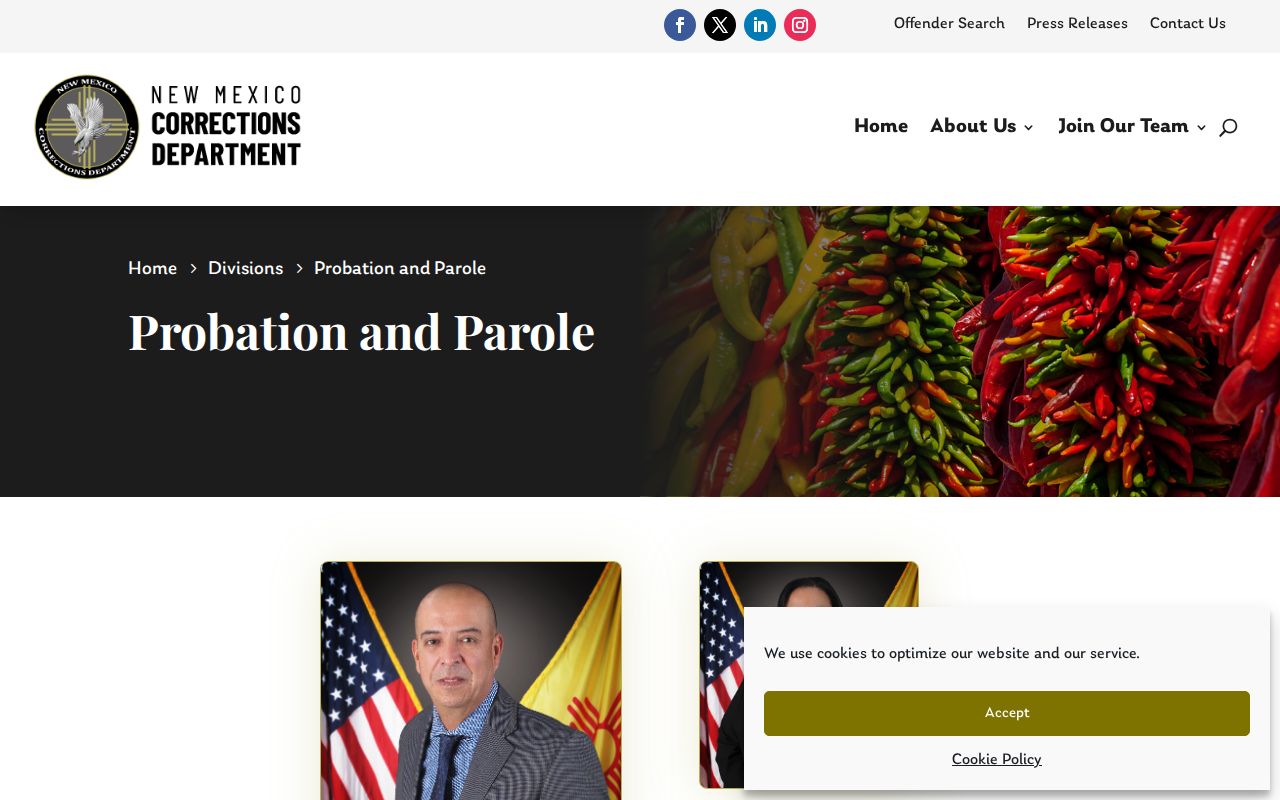
The directory is a route to the correct office, not a person-level discharge certificate. Confirm the individual record with the assigned unit.
GCCF Parole Violator Releases
Guadalupe County has an unusual supervision connection. NMCD identifies Guadalupe County Correctional Facility as a Level 3 state prison that houses male parole violators. A parole violator is a person accused or found to have violated parole after an earlier prison release. Custody at GCCF belongs to the state corrections system, even though the facility name begins with the county’s name and the Santa Rosa complex also has a local detention component.
A person leaving GCCF may be reparoled, discharged, transferred to another NMCD institution, or moved under another valid authority. “Reparoled” means returned to community parole after violation proceedings. It is not the same as final discharge. Search NMCD, obtain the movement or release record, and ask the assigned Probation and Parole office to confirm the public supervision status. The release transaction must also say whether the person entered the community or only moved to another institution.
The place of release does not set the reporting county. NMCD assigns community supervision based on residence, approved release plans, specialized needs, and compact rules. This is why the Santa Rosa gate address cannot identify the office that now handles the case. The official GCCF profile establishes the prison’s role; the live supervision directory establishes the next office.
Guadalupe County Parole Decisions
The Adult Parole Board reports that offender hearings occur weekly at correctional facilities. Those hearings are closed except for statutory victim participation. The Board’s quarterly public meetings and archive concern governance. They are not a public person-by-person hearing calendar, and they are not a searchable set of offender decisions. No official name-searchable decision portal was found in the research.
For one person, gather the NMCD number and sentencing case. Ask the Board Records Manager for the releasable hearing date, type, decision, or order. Use the Board’s own result label. A grant, denial, continuation, rescission, or revocation has a different effect, and a favorable action can still depend on an approved parole plan and signed conditions. It does not prove the day a person physically left GCCF or another state prison.
New Mexico Adult Parole Board
4337 State Road 14
Santa Fe, NM 87508
(505) 827-8853
nmapb.paroleboard@apb.nm.gov
NMSA 1978 §31-21-10 belongs within New Mexico’s broader sentencing framework. Offense-specific rules, consecutive terms, sentence dates, and revocation history can affect eligibility. There is no safe universal first-eligibility formula. The record for the specific sentence controls.
Note: Quarterly Board minutes document public governance business, not a Guadalupe County parole decision for a named person.
Guadalupe County Supervision Violations
Conditions are the rules attached to parole or probation. Their precise terms come from the signed parole conditions or court order. A reported violation can lead to an investigation, arrest order, preliminary hearing, revocation case, or a return to custody. Yet an allegation does not cancel the historical fact that the person had already been released. Keep the prison release date, supervision start, alleged violation, warrant, and new custody event as separate entries.
An absconder status should come from NMCD, not rumor or inference. It means the supervising authority has formally classified the case that way. “Absconder Only” in the NMCD search identifies that unresolved category. It is not a completed discharge and does not, by itself, state where the person is. Verify any warrant through the issuing court or agency. Do not infer a warrant from a missed meeting or an old web result.
VINE can provide a custody alert when a participating agency reports an event, but it is not a parole ledger and does not certify the end of supervision. A transfer or return to prison may create a custody change that needs confirmation through NMCD. Court revocation filings and the supervision record explain the legal cause.
Guadalupe County Supervision Discharge
Completed supervision should end with formal proof. For parole, NMSA 1978 §31-21-10 provides for a final discharge order and certificate after obligations are complete. That certificate is stronger evidence than disappearance from a search page. Ask NMCD records for the parole release, supervision start, office transfers, termination date, and final discharge document. A permanent probation or parole file may remain with the state even after the public search changes.
For probation, obtain the sentencing order and the later court order or certificate that ends probation. New Mexico Courts Case Lookup may show the docket path, but a clerk copy is preferable when the exact language matters. If a violation or revocation case occurred, include it in the chronology. “Terminated,” “unsatisfactory discharge,” and other source labels should not be rewritten as though they mean the same thing.
The core sequence is simple: prison or jail release, community supervision, and formal discharge. Each date answers a different question. When Guadalupe County parole or probation has transferred elsewhere, request the record from the agency that held the case at the relevant time.