
ICE Guadalupe County Scope
No current ICE detention facility or county ICE detention contract was verified in Guadalupe County. ICE is included because it can be the receiving authority after release from local criminal detention, NMCD, BOP, or USMS custody. Do not turn a generic detention-directory listing into a local facility claim.
ICE detention is civil immigration custody. It is separate from the county criminal case, state sentence, or federal prison term that may have come first. The sending agency’s final movement record should identify ICE or a federal handoff when maintained. Then ODLS and ERO can confirm the immigration side. A person can leave the Guadalupe County detention component yet remain confined under ICE.
Search ICE Detainee Status
ICE’s Online Detainee Locator System, or ODLS, accepts a nine-digit A-number and country of birth. Add leading zeroes if the A-number has fewer than nine digits. It also permits a biographical search. Exact spelling, country of birth, and date details matter. The A-number route is usually more precise.
Check a person in this order:
- Open the ICE Online Detainee Locator.
- Enter the nine-digit A-number and country of birth when known. Otherwise use the requested biographical fields.
- Copy the location or status text exactly and note the access time. Do not treat an empty result as proof of release.
- Call the listed detention facility or responsible ERO field office to verify present custody, transfer, or release.
- Compare the result with the sending jail, NMCD, BOP, or USMS movement record and the person’s ICE paperwork.
ODLS does not display people under eighteen. ICE says the system includes people currently detained and people released from ICE custody within the last sixty days. It is not a durable historical archive. A person outside that recent window may require field-office confirmation and a records route.
ICE Release Search Limits
A no-result can have several causes: data timing, spelling, an incorrect A-number, protected information, age limits, release outside the recent window, or a need for field-office help. It does not show that the person was never detained or is now in the community. Check documented name variants and country of birth before calling ERO.
| Search clue | What it supports | What it cannot prove alone |
|---|---|---|
| A-number match | Strong identity key | Current status without verification |
| Facility listed | Reported ICE location | Exact present placement after movement |
| Recent released result | Exit from ICE within the stated window | All later legal obligations |
| No ODLS result | Need for more checks | Community release |
ICE release can carry reporting duties, Alternatives to Detention, parole conditions, or other documents. Alternatives to Detention refers to ICE monitoring outside a detention facility. It is not the same as New Mexico criminal parole.
Albuquerque ICE Release Contact
The Albuquerque ERO check-in office expressly lists Guadalupe County in its coverage. Its page provides the verified office location, telephone number, and currently posted check-in hours. Call ahead because agency hours and appointment instructions can change.
ICE Albuquerque ERO Check-In Office5441 Watson Drive SE
Albuquerque, NM 87106
(505) 452-4700
Tuesday through Thursday, 8 a.m. to 3 p.m.
Use ERO to verify whether the person is detained, recently released, assigned to check in, or covered by reporting paperwork. Provide the A-number, full name, birth date, and country of birth when authorized. The office can explain the current process, but an ODLS inquiry does not replace legal advice or emergency services.
Guadalupe ICE Transfer Records
The sending agency’s record is essential. For a Guadalupe County local booking, request the final custody-movement entry, transfer time, transfer authority, and receiving agency. For NMCD or BOP, obtain the state or federal release and movement record. The ICE entry begins a new civil custody phase; it does not rewrite the prior criminal record.
Read the sequence as a timeline:
Local or prison custody → release from sending facility → ICE transfer → ICE detention or processing → ICE community release, removal, or later movement.
A gap between systems may reflect data timing. Match dates and agency names. If the county record merely says “federal,” ask which agency accepted custody. The Guadalupe County Detention Center release record explains how to request the local final movement.
- A-number
- The immigration identifier used by ODLS.
- ERO
- ICE Enforcement and Removal Operations.
- Order of recognizance
- A document that may permit community release under stated duties.
- Transfer
- A move between custodians, not community freedom.
ICE Check-In Office Source
The official ICE check-in directory identifies the Albuquerque office and its Guadalupe County coverage.
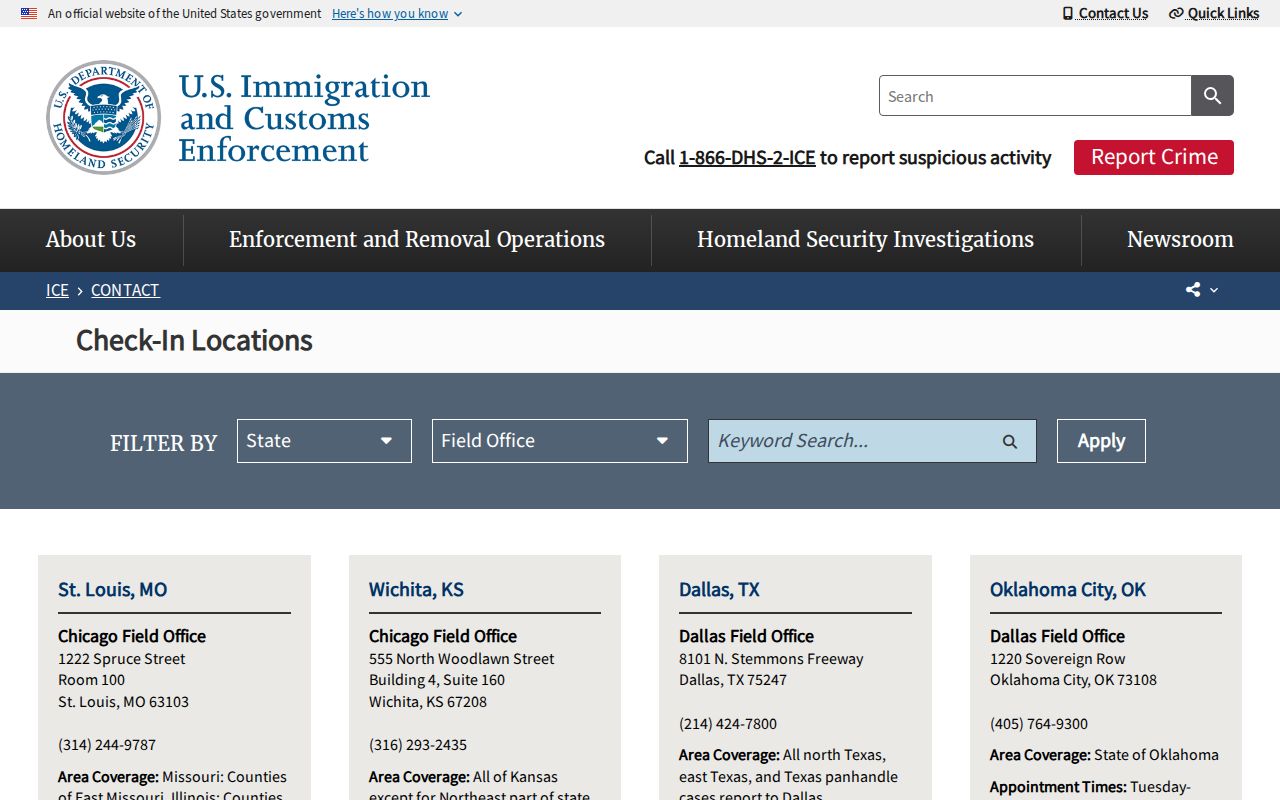
The directory supports the field-office route. It is not a detainee result and does not establish anyone’s custody or compliance status.
ICE Community Release Proof
Paperwork can be stronger than disappearance from ODLS. A released person may possess an I-220A Order of Recognizance, a G-56 call-in letter, immigration parole or Alternatives-to-Detention conditions, or a notice to report. Read the document’s date, A-number, issuing office, and next action. Confirm unclear instructions with ERO or qualified counsel.
An ODLS “released” indication is still tied to ICE’s data and recent window. Pair it with the release document and field-office confirmation. If the person moved into another authority’s custody, obtain that receiving record. A county jail release date, BOP release date, and ICE release date can all be different and all be accurate for their own stages.
Note: Preserve the agency’s exact status language because immigration parole, criminal parole, recognizance, and release have different meanings.
Request ICE Detainee Records
For a record request, identify the person by full name, A-number, date and country of birth, detention facility if known, and a focused date range. Ask for the releasable custody, transfer, detention-location, release, and reporting records needed to document the event. Do not ask ICE to interpret a county or state record it did not create.
If the event began with a Guadalupe County arrest, request the local booking and final movement separately. If it began with BOP or NMCD, request the departure record from that system. Then use the ICE response to complete the chain. This division by record owner prevents one agency’s word “release” from being stretched beyond its actual custody.
No local detention address is listed because no ICE detention center was verified in Guadalupe County. The sidebar and contact card therefore name the regional network and Albuquerque ERO office, not an invented local jail.
ICE and BOP Release Difference
BOP is the federal prison system. ICE operates civil immigration detention. A person can show Released or Not in BOP Custody and then appear in ICE custody. BOP’s monthly release statistics even exclude some departures to another custodial jurisdiction, including ICE detention or deportation.
Search both systems when a federal prison release may lead to immigration custody. Match the BOP register number and release date to the ICE A-number and receiving date through the available records. The Federal Bureau of Prisons release locator page covers the BOP side of that handoff.
When neither system produces a clear result, return to the federal docket and the last confirmed custodian. The last known agency should identify the next movement destination.
ICE Sixty-Day Release Window
ICE’s stated ODLS coverage for released people extends through the prior sixty days. That makes it useful for a recent event but weak as a long-term archive. Record the date of access and the exact status. If the expected release is older, contact ERO and request the relevant record rather than treating an empty screen as evidence that no detention occurred.
The window also differs from a county recent-release request. Guadalupe County publishes no verified online 24-hour or 72-hour feed, while ODLS concerns ICE custody and its own time span. A local jail transfer to ICE might appear in the county movement record first and in the federal system later. Match the person by A-number and compare the timestamps.
If a person was released to check-in obligations, preserve the I-220A, G-56, or other notice and follow its instructions. The Albuquerque office can verify current check-in procedures. A field-office appointment, monitoring condition, or pending immigration case can continue after physical detention ends, so describe that outcome as release from detention rather than the end of all proceedings.