
Detention Center Custody Types
The name of the Santa Rosa complex can cause a serious records error. Official sources support a Guadalupe County Detention Center function for local pretrial and county-sentence custody. They also identify Guadalupe County Correctional Facility, or GCCF, as a Level 3 New Mexico Corrections Department prison. Those are different custody systems even though GEO describes a county detention area and an intake, release, and medical building within the broader complex.
Start with two questions. Was the event a local arrest and booking, or an admission under an NMCD number? Then ask whether the final event was a community release or a transfer. Local arrests by the sheriff, Santa Rosa Police Department, or New Mexico State Police may enter the county detention component. A felony prison commitment can instead send the person from local custody into NMCD. The sending jail may mark that departure as a release from its facility, but the person remains confined.
Detention Center Release Destinations
A local detainee may return to the community after bond, recognizance, dismissal, a court release order, time served, or sentence completion. Recognizance means the court permits release on a promise to appear, subject to its terms. Someone may also leave the Guadalupe County Detention Center for another county, NMCD, federal custody, an outstanding warrant holder, medical custody, or civil immigration custody. Each path produces a different next record.
The final custody-movement entry should state the time, authority, disposition, and receiving agency when those fields are maintained. Compare it with the court docket. A bond order authorizes release only after conditions and holds are cleared. A judgment may commit the person to NMCD. If the destination names GCCF or another state prison, continue with the state system. The broader Guadalupe County released inmate search explains how court, jail, state, and federal records fit together.
| Final event | Best confirmation | Meaning |
|---|---|---|
| Bond or recognizance | Detention movement entry and court order | Possible community release after all holds clear |
| Time served or completion | Release entry and sentence record | County custody may have ended |
| Transfer to NMCD | Receiving prison and NMCD Offender Search | Custody continues under the state |
| Other-agency handoff | Receiving agency and timestamp | Departure is not freedom |
Confirm Detention Center Release Records
Guadalupe County does not publish a verified local jail roster or recent-release feed. The official sheriff page provides contact details, but it has no inmate search, release list, records form, booking-photo screen, or sheriff app. A current list would also be the wrong archive for a person who has already left. Request the final transaction for the specific booking and use the court record as an independent check.
Use a focused sequence:
- Call the Guadalupe County Sheriff’s Office with the full name, date of birth or booking number, and arrest date. Ask whether the person remains physically in local custody.
- If not, ask for the release or transfer time, release type, authority, and destination. Record the exact terms instead of paraphrasing them.
- Search New Mexico Courts Case Lookup for the order, judgment, bond action, dismissal, or later warrant. The court order and jail execution time may differ.
- If the destination is NMCD, another jail, BOP, USMS, or ICE, confirm arrival in that system. Do not stop at the county departure.
- For durable proof, submit an Inspection of Public Records Act request for the booking sheet and final custody-movement entry.
No result in NMCD does not resolve a local booking. NMCD expressly lacks jurisdiction over county and city detention facilities. Likewise, disappearance from an unofficial list cannot prove release. The correct answer comes from the record owner and, when applicable, the receiving agency.
Detention Center Record Requests
Address a local request to the current Guadalupe County records custodian or sheriff/detention custodian. The county site does not identify a jail-record form or a designated detention email. Call first and ask for the current custodian and delivery method. Do not guess an address. Under New Mexico’s Inspection of Public Records Act, a written request should describe existing records with reasonable detail.
Ask for the booking sheet, final release or movement entry, release date and time, release authority, release type, destination or receiving agency, bond record kept with the booking, and booking photograph. Include the person’s full name, birth date if known, booking number, and arrest date. If part of a record is withheld, ask for all reasonably segregable public material and the legal basis for each redaction. County copy fees, hours, and a local response channel were not verified, so confirm them directly.
- Release
- Departure from this facility. It can mean community release or a transfer.
- Transfer
- A move into another agency’s custody.
- Detainer
- A notice that another authority may take custody.
- Disposition
- The stated outcome or destination of the custody event.
New Mexico’s retention schedule lists a jail inmate file for destruction five years after the file closes. That schedule does not promise online display or remove lawful exemptions. It does explain why a historical request can reach beyond a current roster.
Detention Center Records Contact
The verified local starting point is the sheriff. The official page does not post detention records hours, a direct jail line, or release-door instructions. Ask the office to route the call to the detention record owner. Guadalupe County Administration can help locate the current county records custodian if the sheriff cannot identify that person.
Guadalupe County Sheriff’s Office565 River Road, Suite 1
Santa Rosa, NM 88435
(575) 472-3711
Hours not published in the reviewed source
For a court check, the Guadalupe County District Court is at 1448 Historic Route 66, Suite 5, Santa Rosa, and can be reached at (575) 472-3888. The Magistrate Court is at 1633 Historic Route 66 and can be reached at (575) 472-3237. Use the case number when possible.
Santa Rosa Booking Evidence
An official New Mexico Department of Public Safety report provides a useful, limited example: Santa Rosa arrestees in that event were booked into the Guadalupe County Detention Center. It supports the existence of the local booking route, but it does not establish that every arrest follows the same current path.
The state public-safety source is shown below as context.
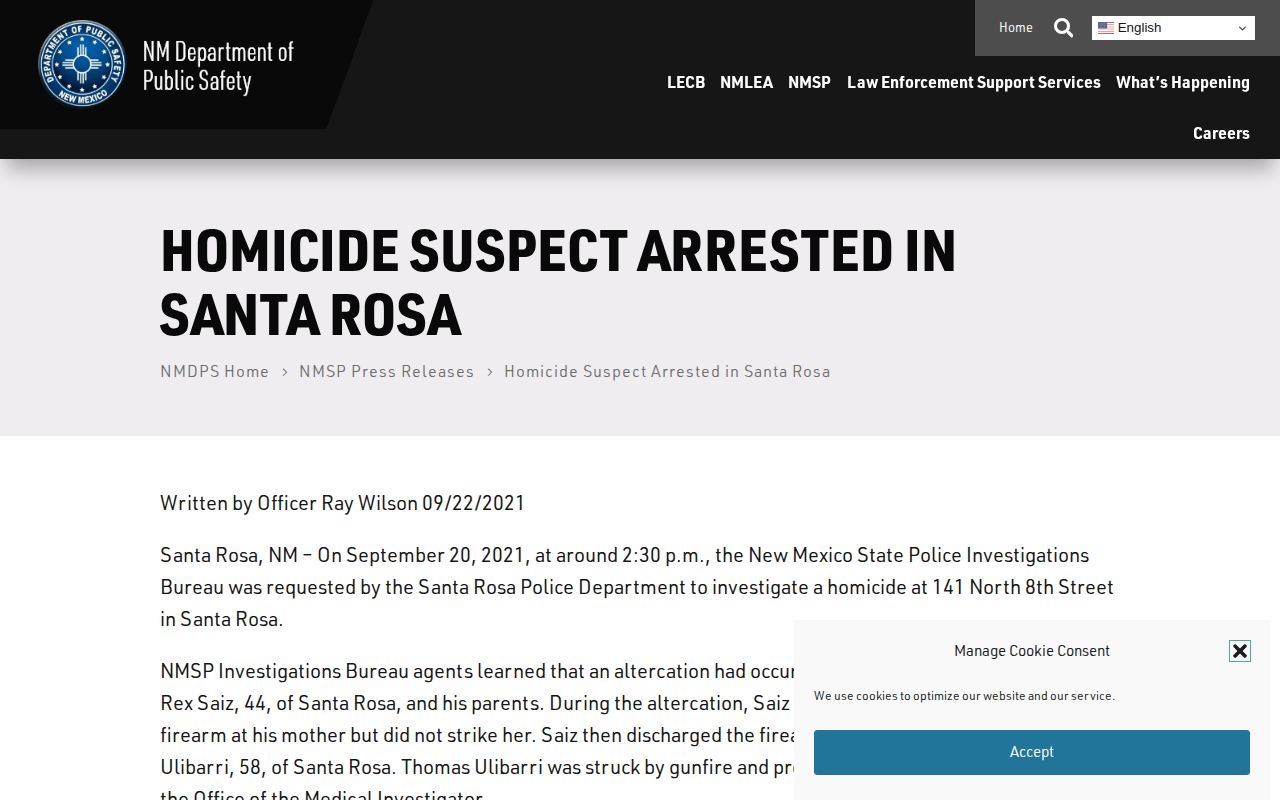
The dated report is not a roster, live status screen, or release record. Always confirm the individual booking and later movement.
Santa Rosa Dual-Use Release Records
GEO describes the complex as having a county detention area plus an intake, release, and medical building. NMCD separately calls GCCF a state prison for male parole violators. This dual use is Guadalupe County’s most important facility detail. A search based only on the complex name can send a local booking inquiry to a state prison system, or send an NMCD case to a county records contact.
Read the identifier before choosing a portal. A local booking number, arresting agency, and county court case point toward detention records. An NMCD number, state sentence, prison location, or parole-violation status points toward NMCD. Then read the final transaction. “Released from the county detention center” and “released from GCCF” are not interchangeable claims.
The court branch also depends on the case. Felonies are handled in the Fourth Judicial District, while misdemeanor and preliminary matters generally pass through Guadalupe County Magistrate Court. The public Magistrate docket shows only the current day and six future days, so it cannot serve as a release archive. Use statewide Case Lookup or clerk copies for the older disposition. Even then, compare the judge’s order with the detention movement, since the court may authorize release before staff clear a warrant, detainer, bond condition, or other lawful hold.
When a release time is disputed, ask for the event log rather than a general status answer. The booking sheet identifies the episode, the court record supplies legal authority, and the final movement provides the executed time and destination. Those three sources can resolve most conflicts without assuming that one public screen contains the whole history.
Note: The shared complex does not merge the legal records, custodians, or release paths of the county and state components.